

The Victory Key
Loading Platform...
Loading Platform...
Officer Grade A (Assistant Manager) in the Information Technology stream at the Securities and Exchange Board of India. Three phases, and an IT paper that decides most of your rank.
No exam date, application window or vacancy figure exists for 2026 yet. Any date circulating elsewhere is not from SEBI. This page is updated within 24 hours of the notification appearing on sebi.gov.in.
The previous cycle — Officer Grade A (Assistant Manager) 2025 — held Phase I on 10 January 2026 and Phase II on 21 February 2026.
Starting basic pay
₹62,500
Gross at Mumbai
≈ ₹1,84,000/mo
IT posts, 2025 cycle
22
In the 2025 cycle, SEBI selected only 22 officers nationwide out of 14,799 applicants for the Information Technology cadre. Nearly one-third (31.8%) of all appointed officers prepared with TVK.

TVK Selections
7 / 22
31.8% of all appointed IT officers
Acceptance Rate
1 in 673
14,799 sat for Phase I
Technical Paper 2
85.88
Median score among selected
In SEBI Grade A IT, Paper 2 is weighted twice as heavily as Paper 1 and constitutes 57% of your entire final merit score. The Victory Key platform delivers full-length, timer-synchronized CBT tests covering SEBI's exact weightage: Database Management (15%), Operating Systems (15%), Networking (15%), Data Structures (10%), and Cyber Security.
Official Gazette Notification (F. No. 320): SEBI Grade A educational qualifications, 60% graduation rule, CGPA benchmarks & Legal stream rules have changed.
Preparing for SEBI Grade A? Get the complete IBPS SO IT Officer course & mock test series bundled together at no extra cost. One unified roadmap, two premier regulatory & banking posts.
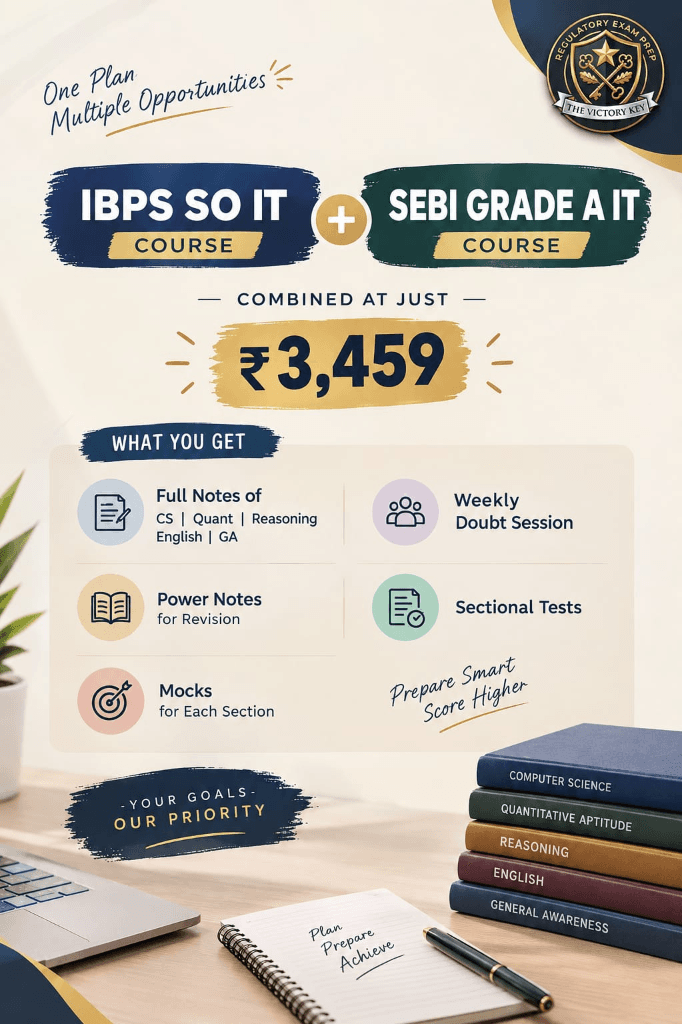
Unlock both SEBI Grade A (IT) and IBPS SO (IT Officer) with a single subscription. Full question banks, CBT-style test engine, and comprehensive study notes.
CS · Quant · Reasoning · English · GA
Direct live guidance & query clearing
Fast recap sheets & formula summaries
Targeted drills for speed & accuracy
Real exam interface, negative marking, instant solutions, sectional timer blocks, and all-India percentile ranking.
At a glance
SEBI recruits Officers in Grade A (Assistant Manager) across seven streams, and Information Technology is its own stream — its own Paper 2 in both written phases, its own cut-offs, its own merit list. You are not competing against the General stream.
Selection is three stages: Phase I, an online screening of two objective papers; Phase II, an online main examination with a descriptive English paper and a stream paper; and Phase III, an interview. Phase I marks are used only to shortlist — they are not counted in the final result.
Current cycle
SEBI has not published the Officer Grade A 2026 notification. Nothing below is a prediction.
| Event | 2025 cycle (concluded) | 2026 cycle |
|---|---|---|
| Notification | 30 October 2025 | To be declared |
| Application window | 30 Oct – 28 Nov 2025 | To be declared |
| Phase I examination | 10 January 2026 | To be declared |
| Phase II examination | 21 February 2026 | To be declared |
| Phase III interview | Intimated to shortlisted candidates | To be declared |
See the full 2025 numbers: cut-offs, competition and selection marks →
Who can apply
As advertised in the 2025 cycle, quoted verbatim from the notification.
Structure
| Paper | Subjects | Marks | Duration | Cut-off |
|---|---|---|---|---|
| Paper 1 | General Awareness (including some questions related to the financial sector, of easy to moderate difficulty), English Language, Quantitative Aptitude, Test of Reasoning | 100 | 60 min | 30% |
| Paper 2 | Information Technology — stream specialisation | 100 | 40 min | 40% |
| Aggregate | 200 | 100 min | 40% | |
You must clear both paper cut-offs and the aggregate. There is no sectional cut-off inside Paper 1. Phase I marks are then discarded — they decide only who sits Phase II.
| Paper | Subjects | Marks | Duration | Cut-off | Weight |
|---|---|---|---|---|---|
| Paper 1 | English (Descriptive Test), to test drafting skills | 100 | 60 min | 30% | 1/3 |
| Paper 2 | Information Technology — MCQs on a mix of logic flow completion, debugging, syntax understanding, program dry-run outputs and data analysis | 100 | 180 min | 40% | 2/3 |
| Aggregate | 50% | ||||
What is tested
SEBI publishes a marks weightage against every topic. That is unusual, and it tells you exactly where the marks are. SEBI marks these weightages indicative only.
| Topic | Weight | What it covers |
|---|---|---|
| Programming Concepts (Java / C / C++) | 30 | Program control (iteration, recursion, functions), scope of variables, binding of variables and functions, parameter passing, functional and logic programming, OOP concepts, inheritance, class and object, constructors, exception handling |
| Database Concepts | 10 | ER model; relational algebra, tuple calculus, integrity constraints, normal forms; file organization, indexing (B and B+ trees), transactions and concurrency control |
| SQL Queries | 10 | Select, view, truncate, delete, update, alter; inner and outer joins; aggregate functions; union, intersection, except; in and exist clauses; nested queries |
| Data Analytics Languages (Python / R) | 10 | Regex, slicing, data reshaping, dataframes, dictionaries and sets, file management, classes and functions, data mining, lists, importing and exporting data, charts and graphs |
| Algorithms for problem solving | 10 | Tree and graph traversals, connected components, spanning trees, shortest paths, hashing, sorting, searching; greedy, dynamic programming, divide-and-conquer |
| Networking Concepts | 10 | ISO/OSI stack, LAN technologies, TCP/UDP, IP, switches, gateways and routers, application layer protocols (DNS, SMTP, POP, FTP, HTTP), firewalls |
| Information & Cyber Security | 10 | Cyber attacks, software development security, network security, authentication, CIA triad, network audit, systems audit |
| Data warehousing | 5 | Data extraction, cleaning, transformation, loading; metadata, data cube, data mart, data models |
| Shell Programming | 5 | Shell scripting basics, shell variables, script arguments, if statement, loop, return, basic UNIX commands |
| Topic | Weight | What it covers |
|---|---|---|
| Data Structure | 40 | Array, linked list, stack, queue, binary tree, indexing, binary search tree, heap, hashing, matrix, JSON objects |
| Algorithms | 30 | Sorting, searching, greedy algorithms, dynamic programming, backtracking, divide and conquer, pattern searching |
| Object Oriented Programming | 20 | Abstraction, encapsulation, polymorphism, inheritance |
| String Manipulation | 10 | Length, substring, regex, search |
Pay
| Without accommodation | ≈ ₹1,84,000 per month |
|---|---|
| With accommodation | ≈ ₹1,43,000 per month |
That figure includes SEBI's contribution to the National Pension Scheme, Grade Allowance, Special Allowance, Dearness Allowance, Family Allowance, Local Allowance, Learning Allowance, Special Grade Allowance and Special Compensatory Allowance.
Other benefits include Leave Fare Concession, medical expenses, eye refraction and knowledge allowances. Residential accommodation is provided subject to availability. Probation is two years. Officers may be posted or transferred to any SEBI office in India, and to any department irrespective of stream.
How you get in
Cost
| Category | Fee |
|---|---|
| Unreserved / OBC / EWS | ₹1,000 application fee cum intimation charges + 18% GST |
| SC / ST / PwBD | ₹100 intimation charges + 18% GST |
A separate online application and a separate fee are required for each stream. The fee is non-refundable, including if you are not shortlisted.
How to prepare
Paper 2 is two-thirds of Phase II, and Phase II is 85% of the final merit. Among the 22 candidates selected in the 2025 cycle, the median Phase II IT score was 85.9 out of 100 — and the median English score was 58. The IT paper is where this exam is won.
70 of the 100 marks are DSA, 20 are OOP, 10 are strings. Database, networking and security carry zero marks in Phase II despite being worth 30 in Phase I. Practise the question style SEBI names: logic flow completion, debugging, syntax understanding, dry-run outputs.
A 180-minute paper rewards candidates who can read unfamiliar code carefully, not those who pattern-match quickly. Practise long sittings, not speed drills.
English is a third of Phase II. The lowest English score among 2025's selected IT candidates was 47 — close to the 30% minimum, where someone would have been out entirely. Write and time one essay and one précis a week.
Programming is 30 marks, but database, SQL, Python/R, algorithms, networking and security are 10 each. You clear Phase I on coverage, then switch entirely to DSA for Phase II.
Sushil discusses the study approach and preparation techniques utilized to succeed in the SEBI Grade A IT exam on the first attempt. Insights include leveraging online resources, structuring descriptive writing, and managing the various phases of the competitive process effectively while balancing professional commitments.
Questions
SEBI has not released it. No exam date or vacancy figure exists for the 2026 cycle yet — any date circulating elsewhere is not from SEBI. The previous cycle was advertised as Officer Grade A (Assistant Manager) 2025, with Phase I on 10 January 2026 and Phase II on 21 February 2026. This page is updated within 24 hours of a new notification.
A Bachelor's Degree in Engineering in any branch, or a Bachelor's Degree in any discipline plus a post-graduate qualification of at least two years in computer science, computer applications or information technology. Any engineering branch qualifies — a CS degree is not required. Maximum age 30, relaxable by 5 years for SC/ST and 3 years for OBC (NCL). No work experience is needed.
Three stages. Phase I is an online screening with two objective papers of 100 marks — Paper 1 on general awareness, English, quantitative aptitude and reasoning in 60 minutes, and Paper 2 on information technology in 40 minutes. Phase II has a 60-minute descriptive English paper and a 180-minute IT paper, both 100 marks. Phase III is an interview.
Phase II carries 85% and the interview 15%. Within Phase II, Paper 1 is weighted one-third and Paper 2 two-thirds. Phase I marks are used only to shortlist and do not count towards the final result.
The pay scale starts at a basic of ₹62,500 and rises to ₹1,26,100 over 17 years. Gross emoluments at Mumbai at the minimum of the scale are approximately ₹1,84,000 per month without accommodation and ₹1,43,000 per month with accommodation, including SEBI's contribution to the National Pension Scheme and allowances.
The 2025 cycle advertised 22 posts in the Information Technology stream — 9 unreserved, 5 OBC (NCL), 4 SC, 2 ST and 2 EWS, along with four PwBD posts. The 2026 figure will be set by that notification.
Yes — one-quarter of the marks assigned to a question, for both papers in Phase I and for the multiple-choice part of Paper 2 in Phase II. Unattempted questions carry no penalty.
Phase I covers programming concepts (30 marks), database concepts, SQL, Python/R data analytics, algorithms, networking, and information and cyber security (10 each), plus data warehousing and shell programming (5 each). Phase II is narrower: data structures (40), algorithms (30), object-oriented programming (20) and string manipulation (10).
In the 2025 cycle the Phase II cut-off for the IT stream was 77.00 out of 100 for unreserved candidates, 75.50 for OBC (NCL), 74.16 for SC, 73.17 for EWS and 71.67 for ST — the highest unreserved cut-off of any stream.
Full-length SEBI Grade A IT mock tests built to SEBI's own topic weightages, previous-year papers and a curated PDF library.
Last verified against SEBI's Officer Grade A (Assistant Manager) 2025 advertisement: 2026-09-20. Official source: sebi.gov.in
Related exams: RBI Grade B · IBPS SO IT · Coal India