
IBPS RRB SO IT:
Officer Scale-II (IT Officer)
182 Information Technology Officer posts across 28 Regional Rural Banks in the 2026 cycle (CRP RRBs-XV). Direct entry into Officer Scale-II through one online examination, tentatively on 20 December 2026, and an interview. No prelims.
IT Officer vacancies 2026
182 posts in 28 RRBs
Single exam (tentative)
20 December 2026
Exam Structure
240 Qs · 200 Marks · 150 Mins
Selection
Single Exam + Interview (80:20)
Mandatory Experience Rule:
Unlike Scale-I General Banking PO, Officer Scale-II Specialist Officer (IT) requires minimum 1 year of post-qualification professional experience in the IT domain.
Cadre Architecture & Recruitment Structure
Key structural facts of the Officer Scale-II Information Technology Specialist Cadre conducted by the Institute of Banking Personnel Selection.
Post Title
Officer Scale-II Specialist Officer (Information Technology Officer) — RRB SO IT
Conducting Body
Institute of Banking Personnel Selection (IBPS) under the Common Recruitment Process for Regional Rural Banks (CRP RRBs-XV, notification dated 1 September 2026)
Participating Banks
28 Regional Rural Banks (Table A of the CRP RRBs-XV notification). The count fell from 43 in 2024 after RRBs within each state were amalgamated.
Vacancies (2026)
182 IT Officer posts: GEN 79, OBC 48, SC 24, EWS 18, ST 13 (Annexure-I as on 25.09.2026; IBPS prints no total, this is the sum of the 28 bank rows). The previous cycle had 90.
Important dates
Applications 1–27 September 2026 (extended from 21 September); edit window 7–8 October 2026; single exam 20 December 2026 per IBPS's tentative calendar; interviews January/February 2027.
Recruitment Stages
Single online objective examination → interview (no prelims)
Final Merit Weightage
Online examination 80% : interview 20%. The interview is out of 100 with a minimum of 40% (35% for SC/ST/OBC/PwBD).
Timing
The 2025 and 2026 notifications give each of the 6 tests its own time (150 minutes in all). Earlier cycles (2023, 2024) used a composite 150 minutes; the 2026 information handout will confirm how sections lock.
Negative Marking
One-fourth of the marks assigned to the question for each wrong answer: −0.25 on the 1-mark tests and −0.125 on the half-mark Language and Computer Knowledge tests. No penalty for a blank.
Medium of Exam
English and Hindi, except the language test, where the candidate chooses English or Hindi
One Single Enrollment, Two Premier Banking Posts
Preparing for IBPS RRB Scale-II (IT Officer)? Get full IBPS SO (IT Specialist Officer Scale-I) mock tests & study notes included in one unified curriculum! Maximize your selection odds across both Nationalized & Regional Rural Banks.
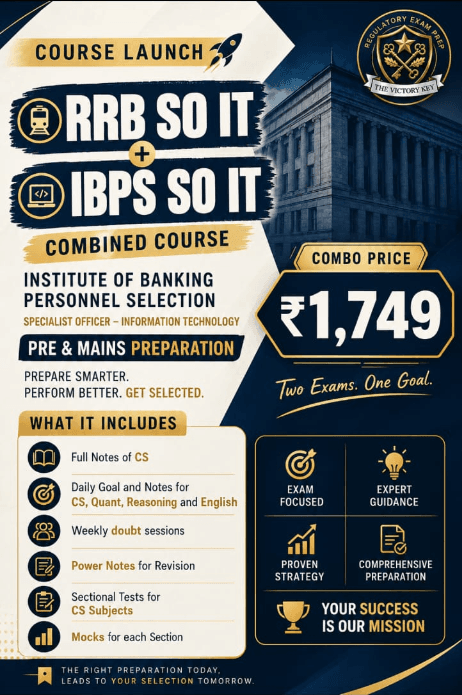
Unlock both IBPS RRB Scale-II (IT Officer) and IBPS SO (IT Specialist Officer Scale-I) with a single subscription. Full question banks, authentic CBT test engine, and downloadable study notes.
Complete IT Syllabus
DBMS, OS, CN, SE, Cloud, Web Tech & Security
Non-Tech Full Prep
Quant, Reasoning, Financial Awareness & English/Hindi
Power Revision Notes
High-yield memory maps & formula recap sheets
Sectional & Topic Drills
Targeted speed builders with negative marking
Full-Length CBT Mocks for Both Exams
Real exam interface, 240-question RRB single-exam simulation + IBPS SO Prelims & Mains mocks with All-India Percentile ranking.
RRB IT Officer Scale 2 Exam Pattern: 240 Questions, 150 Minutes
From the CRP RRBs-XV notification (PDF p.24–25). Candidates need a minimum score in each test as well as a high enough total; IBPS does not publish the minimums.
| # | Test Name | No. of Qs | Max Marks | Duration | Medium of Examination |
|---|---|---|---|---|---|
| 1 | Professional Knowledge (Information Technology) | 40 | 40 | 30 minutes | English & Hindi |
| 2 | Reasoning | 40 | 40 | 30 minutes | English & Hindi |
| 3 | Financial Awareness | 40 | 40 | 15 minutes | English & Hindi |
| 4 | English Language* OR Hindi Language* | 40 | 20 | 30 minutes | English OR Hindi (candidate's choice) |
| 5 | Computer Knowledge | 40 | 20 | 15 minutes | English & Hindi |
| 6 | Quantitative Aptitude & Data Interpretation | 40 | 40 | 30 minutes | English & Hindi |
| Total Aggregate | 240 Qs | 200 Marks | 150 minutes (2 Hours 30 Minutes) | — | |
Professional Knowledge (Information Technology)
Questions
40
Marks
40
Time
30 minutes
Reasoning
Questions
40
Marks
40
Time
30 minutes
Financial Awareness
Questions
40
Marks
40
Time
15 minutes
English Language* OR Hindi Language*
Questions
40
Marks
20
Time
30 minutes
Computer Knowledge
Questions
40
Marks
20
Time
15 minutes
Quantitative Aptitude & Data Interpretation
Questions
40
Marks
40
Time
30 minutes
Total Aggregate: 240 Questions · 200 Marks · 150 minutes (2 Hours 30 Minutes)
Marking Weightage Breakdown
1 mark each for PK, Reasoning, Financial Awareness and QA/DI; 0.5 mark each for the Language test and Computer Knowledge. Five options per question.
Negative Marking Penalty
One-fourth of the question's marks per wrong answer: −0.25 on 1-mark tests, −0.125 on Language and Computer Knowledge. Blank answers carry no penalty.
Professional Knowledge (IT) Subject Blueprint
IBPS publishes no syllabus for the 40-question Professional Knowledge test. The map below is ours, built from the post's degree requirement, IBPS's two published sample PK questions (UNIX file systems, TCP/IP data-link protocols) and memory-based recall of past papers.
Database Management Systems (DBMS & SQL)
- Relational Data Model, ER Modeling, Conceptual & Physical Schema Design
- Normalization Theory: Functional Dependencies, 1NF, 2NF, 3NF, BCNF, 4NF, Lossless Decomposition
- Transaction Processing: ACID Properties, Serializability, Concurrency Control (2PL, Timestamping)
- Database Recovery Techniques, Deadlock Handling & Log-Based Recovery
- Advanced SQL: DDL, DML, Joins (Inner, Left, Right, Full Outer), Subqueries, Aggregate Functions
- Database Indexing (B-Trees, B+ Trees, Hash Indexes), Views, Triggers, and Stored Procedures
- NoSQL Database Fundamentals: Document, Key-Value, Columnar & Graph Store Concepts
Operating Systems & System Architecture
- Process Management: Process States, PCB, Context Switching, Inter-Process Communication (IPC)
- CPU Scheduling Algorithms: FCFS, SJF, SRTF, Round Robin, Priority Scheduling, Multilevel Queues
- Process Synchronization: Critical Section Problem, Semaphores, Mutex, Monitors, Classical Sync Problems
- Deadlock: Prevention, Avoidance (Banker's Algorithm), Detection, and Recovery Strategies
- Memory Management: Swapping, Contiguous Allocation, Paging, Segmentation, Virtual Memory
- Page Replacement Algorithms: FIFO, LRU, Optimal, Clock, Thrashing & Working Set Model
- File Systems & Storage: File Allocation Methods, Directory Structures, Disk Scheduling (SSTF, SCAN, C-SCAN)
- Linux/Unix Administration: Shell Scripting Basics, File Permissions (chmod/chown), Process Signals, grep/sed/awk
Computer Networks & Cyber Security
- Layered Network Architectures: OSI 7-Layer Reference Model vs. TCP/IP Protocol Stack
- Data Link Layer: Framing, Flow Control (Stop & Wait, Go-Back-N, Selective Repeat), Error Detection (CRC), CSMA/CD
- Network Layer: IPv4 & IPv6 Addressing, Subnetting, Supernetting, CIDR, NAT, ARP/RARP, ICMP
- Routing Protocols: Distance Vector (RIP), Link State (OSPF), Path Vector (BGP), Distance Vector Routing Loop fixes
- Transport Layer: TCP Connection Management (3-Way Handshake, SYN/ACK, FIN), Flow Control, Congestion Control (Tahoe/Reno), UDP
- Application Layer Protocols: DNS Hierarchy, HTTP/1.1 vs HTTP/2, HTTPS, FTP, SMTP, POP3, IMAP, DHCP
- Information Security & Cryptography: Symmetric (AES, DES) vs Asymmetric (RSA, ECC), Hash Functions (SHA-256, MD5)
- Digital Signatures, Public Key Infrastructure (PKI), SSL/TLS Handshake, Firewalls, IDS/IPS, VPN (IPSec)
- Common Cyber Threats: Phishing, SQL Injection, Cross-Site Scripting (XSS), Man-in-the-Middle (MITM), Ransomware, DDoS
Data Structures & Algorithms
- Linear Data Structures: Arrays, Linked Lists (Singly, Doubly, Circular), Stacks, Queues, Circular Queues, Deques
- Stack Applications: Infix to Postfix/Prefix Conversion, Expression Evaluation, Recursion Call Stack
- Non-Linear Data Structures: Binary Trees, Binary Search Trees (BST), Tree Traversals (Inorder, Preorder, Postorder)
- Self-Balancing Trees: AVL Trees (Rotations), Red-Black Trees, B-Trees, B+ Trees
- Priority Queues & Heaps: Min-Heap, Max-Heap, Heapify, Heap Sort
- Graph Algorithms: Graph Representation (Matrix vs Adjacency List), BFS, DFS, Topological Sort
- Shortest Path & MST: Dijkstra's Algorithm, Bellman-Ford, Prim's and Kruskal's Algorithms
- Algorithm Analysis: Asymptotic Notations (Big-O, Omega, Theta), Space & Time Complexity Trade-offs
- Searching & Sorting: Binary Search, Quick Sort, Merge Sort, Counting Sort
Software Engineering & Object-Oriented Programming (OOP)
- Software Development Life Cycle (SDLC) Models: Waterfall, Incremental, RAD, Spiral, Agile & Scrum Frameworks
- Software Requirements Engineering: Functional vs Non-Functional Requirements, SRS Document, Use Case Diagrams
- Software Design Principles: Modularity, Coupling & Cohesion, Architectural Styles, UML Class Diagrams
- Object-Oriented Concepts (Java/C++): Abstraction, Encapsulation, Inheritance, Polymorphism (Overloading vs Overriding)
- Software Testing Methodologies: Black-box vs White-box Testing, Unit, Integration, System, Acceptance, Regression Testing
- Software Quality Assurance & Cost Estimation: McCall Quality Metrics, COCOMO Model, Cyclomatic Complexity
- Version Control & Modern Engineering: Git Workflows, Branching, Merging, CI/CD Pipeline fundamentals
Banking Technology, Fintech & Regulatory IT Standards
- Core Banking Solutions (CBS): Architecture, Multi-tier Deployment, Centralized Transaction Processing
- Electronic Payment Systems: RTGS, NEFT, IMPS, UPI, NACH, AePS, BBPS Protocols and Clearing House Mechanisms
- ATM & POS Switching Networks: ISO 8583 Messaging Standard, HSM (Hardware Security Modules), EMV Chip Security
- RBI Cyber Security Framework: IT Governance, Cyber Crisis Management Plan (CCMP), SOC (Security Operations Center)
- Disaster Recovery (DR) & Business Continuity Planning (BCP): RPO (Recovery Point Objective), RTO (Recovery Time Objective)
- Data Protection & Regulatory Compliance: RBI Guidelines on Digital Lending, KYC/AML Systems, CERT-In Reporting Norms
Computer Organisation, Architecture & Emerging Tech
- Digital Logic & Microprocessors: Boolean Algebra, Logic Gates, Multiplexers, Decoders, Flip-Flops, Registers, Counters
- Computer Architecture: Instruction Cycle, Addressing Modes, RISC vs CISC Architecture, ALU & Control Unit Design
- Memory Hierarchy: Cache Memory Mapping (Direct, Associative, Set-Associative), Cache Misses, Memory Interleaving
- Instruction Pipelining: Pipeline Hazards (Structural, Data, Control), Branch Prediction
- Web Technologies: HTML5 Semantics, CSS3, JavaScript ES6+, XML, JSON, RESTful Web Services
- Cloud & Virtualization: IaaS, PaaS, SaaS, Public/Private/Hybrid Cloud Models, Virtual Machines vs Docker Containers
RRB IT Officer Scale 2 Cut Off (2024 vs 2023, unofficial)
IBPS shows scores only to candidates and publishes no cut-off list for this post. These figures are as reported by coaching sites, which do not agree on whether they are written-exam scores or final scores out of 100. Use them as a rough guide only.
General (UR)
55.75
2023: 49.75
OBC (NCL)
55.75
2023: 48.75
EWS
55.75
2023: 45.00
SC
49.50
2023: 35.75
ST
48.50
2023: 27.75
2024 Sectional Minimums:
Professional Knowledge: 5.25 / 40 (General/EWS), as reported by one coaching site. Minimums for the other tests have not been reported by any source we could find.
Educational Qualification & Mandatory Experience
As stated in the CRP RRBs-XV notification (PDF p.7 and p.18–20).
Educational Qualification
Bachelor's degree from a recognised University in Electronics / Communication / Computer Science / Information Technology or its equivalent with a minimum of 50% marks in aggregate. IBPS does not name BCA or MCA; they would have to count as "equivalent".
Work Experience
One year in the relevant field, as on 21.09.2026 (the original closing date; the extension to 27 September did not move it).
Age Limit
Above 21 and below 32 years as on 01.09.2026, i.e. born between 02.09.1994 and 01.09.2005 (both inclusive). Relaxation: SC/ST 5 years, OBC (non-creamy layer) 3 years, PwBD 10 years, ex-servicemen commissioned officers with 5 years' service 5 years.
Desirable Certifications
Certificate in ASP, PHP, C++, Java, VB, VC, OCP etc. (listed as desirable, not essential).
Local Language
Not required for Officer Scale-II. Local-language proficiency is essential only for Scale-I and Office Assistant posts.
Nationality / Citizenship
Citizen of India, subject of Nepal, subject of Bhutan, or Tibetan refugee settled in India prior to January 1, 1962.
Work Experience Verification
During document verification and common interview, candidates must produce formal experience letters and salary slips proving at least 365 days (1 full year) of post-qualification employment.
Eligible Professional Roles:
• Software Developer / Web Engineer
• Network Administrator / Cyber Security
• Database Administrator (DBA)
• System Engineer / IT Support Specialist
RRB IT Officer Scale 2 Salary
What is and isn't documented. IBPS's RRB notifications state no pay scale, so the figures below are indicative.
What IBPS says
IBPS's RRB notifications (2023–2026) do not state a pay scale or a probation period for Officer Scale-II.
Scale-II basic in public-sector banks
₹64,820 – 2,340/1 – 67,160 – 2,680/10 – 93,960 (the MMGS-II scale, as printed in an SBI recruitment addendum of 2024)
Does it apply to RRBs?
RRB officers have historically followed the public-sector bank scales through a Government order; we have not seen the order for the 2024 revision, so treat ₹64,820 as indicative.
Allowances
Dearness, house-rent and other allowances are added to the basic pay; their current rates are not in any IBPS document, so we do not quote an in-hand figure.
80:20 Merit Ratio & Allotment Stages
The final merit list is based 80% on the single online examination score and 20% on the common interview.
Single Online Examination (200 Marks)
Objective online examination conducted by IBPS: 6 tests, 240 questions, 150 minutes, five options per question.
Minimum in Each Test + Total Score
Candidates must score a minimum in each test and be high enough in the total score; up to three times the vacancies in each category are called for interview. IBPS does not publish the minimums.
Interview (100 Marks)
Co-ordinated by a Nodal RRB with NABARD and IBPS. Minimum qualifying marks: 40% (35% for SC/ST/OBC/PwBD).
Final Merit (80:20)
Online examination 80% and interview 20%. Candidates are allotted to participating RRBs by merit and preference.
What's inside the RRB SO IT course
Full-length 240-question mocks and Professional Knowledge tests in the IBPS Scale-II pattern, with an explanation for every question. The list below updates itself as tests are published.
What the course covers
| Full-length mock | 240 questions in the IBPS Scale-II pattern: 6 separately timed tests, five options per question and one-fourth negative marking. |
|---|---|
| Professional Knowledge tests | Sectional PK tests on networks, DBMS & SQL, operating systems, data structures, programming and security. |
| Answer explanations | Every question in the new RRB SO IT tests has a written explanation. |
| Results | Score per test, total score and a rank among TVK test-takers as soon as you submit. |
| Device access | Works in the browser on phone, tablet and desktop. |
RRB SO IT CBT Mock Test Series (240 Qs · 200 Marks)
RRB SO IT tests are being published
Full-length 240-question mocks and Professional Knowledge tests in the IBPS Scale-II pattern will appear here as soon as they are published.
Specialized PDF Study Material & Banking IT Handouts
Banking IT & Professional Knowledge Library
Specialized study modules for Core Banking Solutions (CBS), RBI cyber security directives, DBMS, and networking are accessible directly in the platform PDF Library.
TVK+ All-Access Pass
RRB SO IT Preparation Pass
Get all-access pass to current and upcoming RRB SO IT mock tests, technical study modules, and verified regulatory syllabus guides.
Frequently Asked Questions
Verified answers to the most common doubts regarding RRB Specialist Officer (IT) recruitment.
What is the IBPS RRB IT Officer Scale 2 exam date 2026?
IBPS's tentative calendar lists 20 December 2026 for the Officer Scale II and III single examination. The CRP RRBs-XV notification gives the window as December 2026/January 2027. Call letters had not been released as of 24 October 2026.
How many RRB IT Officer vacancies are there in 2026?
182 Officer Scale-II (IT) posts across the 28 participating RRBs as on 25 September 2026: GEN 79, OBC 48, SC 24, EWS 18 and ST 13. The largest are Gujarat (28), Uttar Pradesh (25) and West Bengal (19). The previous cycle had 90.
Is there a Preliminary Exam for IBPS RRB SO IT (Officer Scale-II)?
No. Officer Scale-II has a single online examination of 240 questions for 200 marks in 150 minutes, followed by an interview.
Does the RRB SO IT exam have sectional timing?
The 2025 and 2026 notifications give each test its own time: 30 minutes for Professional Knowledge, Reasoning, the Language test and Quant/DI, and 15 minutes for Financial Awareness and Computer Knowledge. The 2023 and 2024 notifications used a composite 150 minutes, so check the 2026 information handout when it is released.
What is the negative marking in the RRB IT Officer exam?
One-fourth of the marks assigned to a question is deducted for each wrong answer: 0.25 on the 1-mark tests and 0.125 on the half-mark English/Hindi and Computer Knowledge tests. Blank answers carry no penalty.
Can a fresher apply for RRB IT Officer?
No. The post requires one year of experience in the relevant field, reckoned as on 21 September 2026 for this cycle, in addition to a relevant bachelor's degree with 50% marks.
Are BCA and MCA eligible for RRB IT Officer?
IBPS asks for a bachelor's degree in Electronics, Communication, Computer Science or Information Technology "or its equivalent" with 50% marks. It does not name BCA or MCA, and it does not define equivalence, so check with the notification's helpdesk before relying on either.
Is local language required for RRB Scale 2 IT Officer?
No. The notification makes local-language proficiency essential only for Officer Scale-I and Office Assistant posts.
What is the age limit for RRB IT Officer Scale 2?
Above 21 and below 32 years as on 1 September 2026 (born 2 September 1994 to 1 September 2005), with 5 years' relaxation for SC/ST, 3 for OBC (non-creamy layer) and 10 for PwBD.
What is the salary of an RRB IT Officer Scale 2?
IBPS does not state a pay scale in its RRB notifications. In public-sector banks the Scale-II (MMGS-II) basic pay is ₹64,820 rising to ₹93,960, and RRB officers have historically followed those scales, but we have not seen the Government order for the current revision, so treat it as indicative.
Official IBPS Documents
Dates, vacancies, eligibility and the exam pattern on this page come from these IBPS documents:
CRP RRBs-XV detailed notification (revised)
Institute of Banking Personnel Selection (IBPS)
Eligibility (PDF p.19), age (p.7), exam pattern (p.24), negative marking and shortlisting (p.25), interview and 80:20 merit (p.26).
CRP RRBs-XV vacancies, Annexure-I as on 25.09.2026
IBPS
Officer Scale-II (IT) vacancies by RRB and category (PDF p.4).
Corrigendum: registration extended to 27.09.2026
IBPS
All other terms, including the 21.09.2026 eligibility date, unchanged.
IBPS tentative calendar 2026–27
IBPS
Officer Scale II & III single examination: 20 December 2026 (tentative).
CRP RRBs-XV page
IBPS
Call letters, information handout and results will be posted here.
Prepare for RRB SO IT with the exact 240-question pattern
Topic-wise professional knowledge notes, banking technology briefs, and simulated CBT tests with strict sectional timings.
Where the figures come from
• IBPS CRP RRBs-XV notification (01.09.2026, revised 05.10.2026), its corrigenda and the vacancy annexures.
• IBPS tentative calendar 2026–27 (16.01.2026).
• Scale-II basic pay: SBI recruitment addendum of 2024 (a public-sector bank document; IBPS's RRB notifications state no pay scale).
Dates, vacancies, eligibility and the exam pattern are taken from IBPS's documents linked above. The Professional Knowledge topic list is our own map (IBPS publishes no PK syllabus), and pay figures are indicative as explained in the salary section.
Last verified against official documents: 2026-10-24